
Newborn Feeding Guide: How Often to Feed Your Baby and What’s Normal
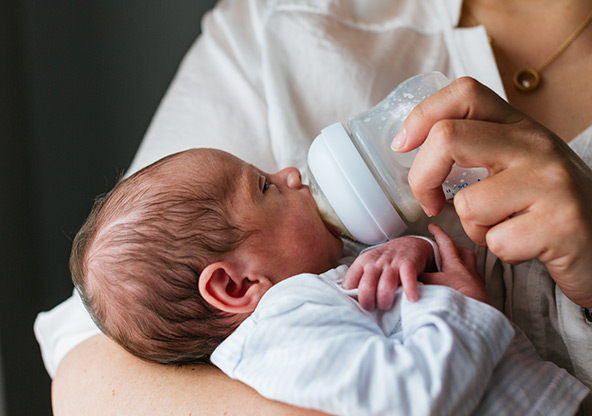
The first few weeks with a newborn baby are a whirlwind. It’s a cycle of feeding, diaper changes, naps, and wondering if you’re doing it all right.
The good news is that you’ll soon get the hang of it. Learning your baby’s hunger cues, feeding patterns, and common behaviors will help you feel more confident at feeding time. While you learn about these cues, here are some answers to your newborn feeding questions for breastfed, bottle-fed and formula-fed babies.
This information is not medical advice. Always follow your pediatrician’s recommendations and contact your doctor’s office with any questions.
Is My Baby Eating Enough?
These signs can help you tell if your baby is getting enough to eat:
- Are they having wet diapers?
- Are they gaining weight?
- Do they seem content after a feed?
If you answer yes to these questions, your baby is more than likely eating enough. If you are unsure, call your pediatrician.
| Baby's Age | Nursing at the Breast | Breast Milk Bottle | Formula Bottle | What Parents Should Expect |
|---|---|---|---|---|
| Birth to 1 Week | Every 1-3 hours | 1-2 oz every 2-3 hours | 1-2 oz every 2-3 hours | Frequent feeding and waking are normal. |
| 1-4 Weeks | Every 2-3 hours | 2-3 oz every 2-3 hours | 2-3 oz every 3-4 hours | Some babies cluster feed, especially in the evening. |
| 1-3 Months | Every 2-4 hours | 3-4 oz every 3-4 hours | 3-4 oz every 3-4 hours | Some babies begin to follow a more predictable routine. |
Remember: Every baby is different. Feed your baby when they show hunger cues and follow your pediatrician's recommendations. Keep reading to learn more.
How to Tell if My Baby is Hungry
The American Academy of Pediatrics recommends responsive, or on-demand feeding, which is feeding when they begin to show hunger cues.
Hunger cues include:
- Rooting, or moving their head from side to side, looking for the breast or the bottle
- Bringing hands to mouth
- Lip smacking or licking their lips
- Opening their mouth
At least for the first month of life, you should expect your baby to be eating at least every 2-3 hours, from the start of the feed to the start of the next feed.
For example, if your baby starts eating at 8 a.m., their next feed should start at 10 a.m., regardless of how long the previous feed lasted.
How to Tell if My Baby is Full
If you’re breastfeeding, your baby will unlatch or turn away from your breast when they are full. A breastfed baby will rarely overeat.
If you’re feeding by bottle, either formula or breastmilk, your baby may show more subtle signs that they are full.
Signs your baby may be full:
- Turning away from the bottle
- Relaxed hands
- Slowing or stopping sucking
- Falling asleep during or after a feed
- Starts fidgeting or loses interest
Directly breastfed babies may sometimes stay at the breast even after they're no longer actively eating. Babies may do this for comfort, to help them relax or fall asleep, or simply because they enjoy being close to you. If your baby is sucking with only occasional swallows, this can be a normal part of breastfeeding. These quiet moments can provide comfort, closeness and opportunities for bonding between you and your baby.
Newborn Feeding Schedule 0-3 months
This is a general guideline. It is not uncommon for babies to eat more frequently, and sometimes it can continue until they are consistently eating solids. Talk to your doctor about specific guidelines for you and your baby.
First days: every 1-2 hours
First weeks: 2-3 hours
By 1 month: most babies will show a predictable pattern, but always feed based on hunger cues and doctor recommendations.
Should I Wake My Baby to Eat at Night?
Many babies will naturally wake up every few hours during the night to eat. Breastfed babies tend to wake up more frequently, sometimes as often as every 2-3 hours since the start of the last feed.
If your baby doesn’t wake up after four hours since their last feed, your pediatrician may recommend waking them up to feed them. Newborn babies need constant nutrition and calories for proper brain development and growth. Frequent wakings also reduce the risk of SIDS, especially during the first few months.
Once they are approximately 3 months or 12 pounds or more, you can ask your doctor about letting them sleep in longer stretches.
Is My Baby Cluster Feeding?
Cluster feeding is when babies are hungry much more frequently than normal, sometimes needing to be fed back-to-back for a few hours at a time. This is more common in the evenings and is typically a sign of a growth spurt. Cluster feeding usually lasts a few hours at a time.
For breastfed babies, this behavior is a natural way to boost your milk supply in the first few days of life.
You should never restrict your baby from eating when they’re hungry, especially not a newborn.
How Much Should My Newborn Eat?
Directly Breastfed Babies
Most health guidelines recommend exclusively breastfeeding your baby for at least 6 months, if possible. Once solids are introduced, it is recommended that babies continue breastfeeding as the base of nutrition for up to 2 years, as long as mom and baby still want to.
Breastfeeding is not easy, and every family is different. Breastfeeding may not be possible or best for you, and that is okay. You should do what is best for you and your family.
Breastfed babies typically eat more frequently than formula-fed babies, as formula is more calorie-dense and consistent. Breastmilk is dynamic, changing with your baby’s needs and growth.
Since you are unable to measure how much milk your little one is getting when breastfed, you must rely on other factors to determine if they’re getting enough.
Questions to ask:
- Are they having wet diapers?
- Are they gaining weight?
Note: It’s normal for babies to drop weight after birth, but they should gain it back in the next 2 weeks. - Are they content after feeding?
- Do they eat frequently?
If you answer yes to these questions, your baby is most likely eating enough.
If you're still not sure or need more peace of mind, you can use a weighted feed. A weighted feed is when you weigh your baby right before breastfeeding, provide a full feeding, and then weigh your baby again. The weight gained during the feeding can help determine how much milk your baby is getting during the nursing session. Ask your pediatrician or lactation consultant about weighted feedings.
Bottle-fed Babies
Finding out how much your baby needs in a bottle is a trial-and-error process during the first few feedings.
Most health care professionals recommend starting with 2-3 ounces of formula or breast milk and then gauging how your baby reacts. Are they still sucking for more milk when the bottle is empty? Are they fussy and still acting hungry? Try another ounce at the next feeding. Are they pulling away from the bottle, or spitting up an excessive amount before the bottle is empty? Try an ounce less at the next feeding.
How Much Formula Should I Feed My Baby?
If you are unable or don’t want to breastfeed, formula is the safest and most effective alternative.
Always make the formula bottle according to the instructions on the formula container, with guidelines from your pediatrician.
By the first month, your baby may increase how much formula they can eat by an ounce.
How Much Breastmilk Should I Bottle-feed My Baby?
The rule of thumb for breast milk is to feed your baby 1-1.5 ounces per hour since they last ate. So if they last ate 2 hours ago, try to bottle-feed 2-3 ounces and see how they react. Once you figure out how many ounces are right for your baby, stick with it.
Breast milk is dynamic, and as your baby grows, your breast milk will increase caloric density. Because of this, you likely won’t have to increase the amount of breastmilk you bottle-feed your baby.
Hiccups After Feeding Your Newborn
Those tiny hiccups can sound big—but they’re normal.
Hiccups in newborns are usually nothing to worry about. Babies often get hiccups during or after feeding, whether they’re breastfed or bottle-fed. Hiccups often happen when your baby swallows air during a feeding or when their stomach becomes full.
The good news is that hiccups bother parents more than they bother the baby. They’re painless and usually go away on their own.
If hiccups happen during a feeding, or if you want to try to prevent them, here are some things you can try to relieve or manage hiccups in your baby.
- Burp your baby during and after feedings
- Feed your baby before they become very upset or extremely hungry
- Pause the feeding and try changing your baby's position
- Hold your baby upright for a short time after feeding
- Resume feeding once your baby is calm and comfortable
While hiccups are usually harmless, talk to your pediatrician if your baby frequently has other symptoms, such as arching their back during feedings, unusual fussiness during or after feedings, poor feeding, or forceful spit-up. These symptoms may need further evaluation.
Feeding Concerns: When to Contact Your Pediatrician
Although every baby is different, there are some things to look out for that could be a sign that something needs medical attention. When it comes to your newborn, you should contact your pediatrician with any concerns. Trust your gut when something may be wrong, or if you just need peace of mind.
Contact your baby’s doctor if:
- Your baby is difficult to wake for feedings
- He or she refuses more than one feeding
- He or she isn’t producing wet diapers
- He or she isn’t gaining weight
- Or if they’re showing signs of dehydration (Dry mouth or lips, fewer than 6 wet diapers in a 24-hour period, or a sunken soft spot on the head)
If you aren’t sure if something is wrong, it is always best to contact your doctor just in case.
You Know Your Baby Best
The first few weeks with a newborn are hard and full of questions. It’s okay if you don’t feel like you know your baby well yet. Although they’ve been in your belly for the past 9 months, it is your first time meeting each other, and it takes time, just like any relationship.
Soon, you’ll know and understand your baby, their patterns, personality and preferences.
Newborn feeding isn’t about following a perfect schedule or mirroring what your first baby needed. It’s about learning your baby’s signals and building confidence one feeding at a time.
If you have questions or need peace of mind, contact your pediatrician or lactation specialist.
